

Herp Update: Jefferson & Blue-spotted Salamanders, Spring Amphibian Migration, and Missing Reports

Jefferson and Blue-spotted Salamanders
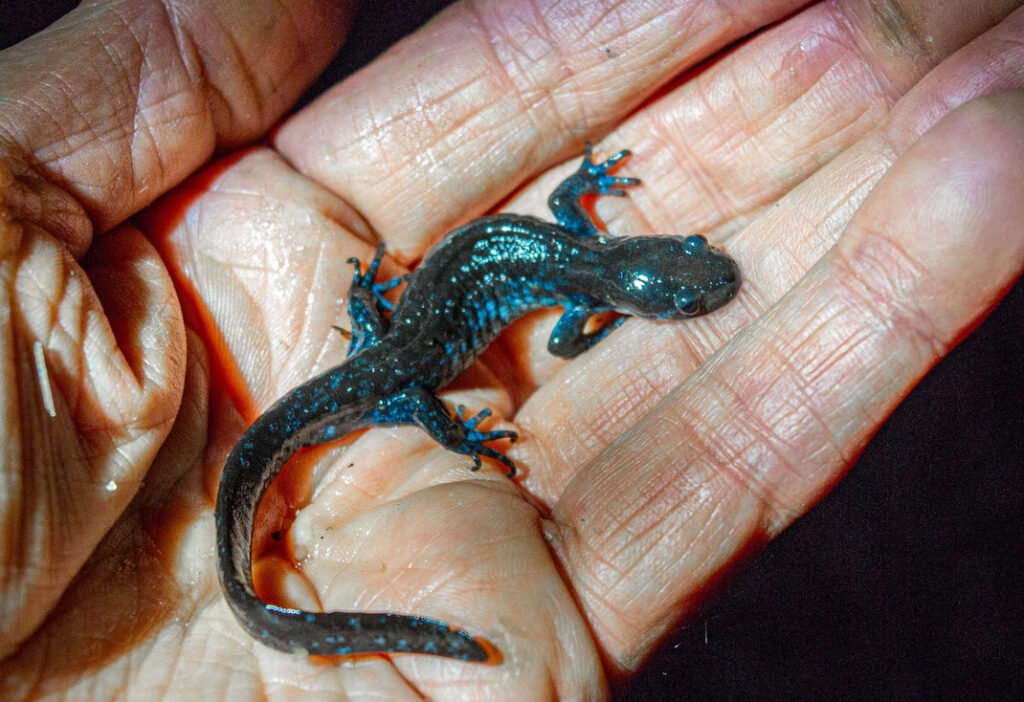
Morgan LaChance took the photo below of what we are calling a female Jefferson Group Salamander on March 26 in Huntington. Since Jefferson Salamanders hybridized in the past with Blue-spotted Salamanders, it is sometimes difficult to be sure whether we are looking at a hybrid or a purebred, and if it’s a hybrid, which end of the hybrid spectrum it belongs to. If the salamander has a squared and swollen vent, it is a male, so we should be able to identify it to species. The hybrids have a 99.9 % chance of being female. The hybrid females need to have male sperm in order for their eggs to develop, so hybrid females are found with either pure Jefferson Salamander males and look mostly like Jefferson Salamanders, or they live and breed with Blue-spotted Salamander males and look mostly like Blue-spotteds.

The salamander above is a female, so it could well be a hybrid, but it has many Jefferson Salamander characteristics. It has a wide grayish-brown head (Blue-spotteds have a narrower head and a short, rounded snout). The spots are small flecks confined to the lower sides (Blue-spotteds usually have larger bluer blotches that extend further up the sides and tail). Our salamander also has a light gray stripe along the top of its tail, which is not found in a Blue-spotted. Lastly, the general background color of pure Jefferson Salamanders is grayish-brown, and the background color of pure Blue-spotteds is almost black.
In addition, the hybrid females use the same habitat as the pure males they live with. So habitat can be a clue. Pure Jefferson Salamanders prefer isolated upland ponds that are either long-lasting vernal pools, semipermanent pools, or permanent ponds. They also like rocky, deciduous woodlands. Blue-spotteds are usually found near lowland floodplain pools, forested swamps, or the edges of large marshes.
The salamander in the photo above has a broad grayish-brown snout, small light flecks confined to the lower sides, and a light brown ridge on its tail. Hence, we are calling it a Jefferson Group Salamander. Meaning it is either a pure Jeff female, or a hybrid female that lives and breeds with pure Jeff males. I have reposted Chris Fastie’s Blue-spotted Salamander photo below for comparison.
Spring Amphibian Migration
On the evening of Thursday, March 26, Otter Creek Audubon Society and the Salisbury Conservation Commission held their second and final (for the year) public crossing event on Morgan Road here in Salisbury. The amphibian migration started off fairly slowly and gradually increased as our two-hour monitoring period continued. By 9:30, amphibians were moving steadily across the road. The 23 volunteers helping moved 489 Blue-spotted Salamanders, 234 Eastern Red-backed Salamanders, 154 Four-toed Salamanders, 82 Spotted Salamanders, 38 Wood Frogs, and three Eastern Newts. This adds up to a total of exactly 1,000 amphibians identified and moved while we were there. Eight amphibians were killed by the few vehicles that passed through.
Many people from other towns reported migration of the same species, plus some Jefferson Salamanders from Huntington and Killington, and even a Gray Treefrog moving in Brattleboro, Northern Leopard Frogs in Salisbury, and sightings of North American Green Frogs in Lincoln and a North American Bullfrog in Huntington.
Although most of the amphibian migration so far this spring has been in the Lake Champlain Basin or other low-elevation sites in southern Vermont, based on the current forecasts, I expect migrations to be much more widespread in Vermont both tonight and this coming Sunday.
Amphibian crossing events are organized in many towns in Vermont and serve a variety of functions. Our crossing nights on Morgan Road in Salisbury are primarily educational, but we also gather data and move amphibians off the roads. Morgan Road is a quiet back road with not much traffic. So, it is family-friendly and a great place to introduce people to a variety of amphibians and the wonder of amphibian migrations. Other organizations promote crossing activities whose primary purposes are to save amphibians from getting run over or to document the species that occur at those crossings. Some crossings take place on busy roads where amphibian mortality could be quite high. Keep in mind that the busy roads are not safe for young children.
The North Branch Nature Center and the Bonnyvale Environmental Education Center are two organizations that have educational materials online for the crossings that they organize.
There are hundreds of crossing areas in Vermont, with multiples in almost all towns, so you can also find your own. If you do, we would love to know where you were and what you found. Perhaps you can fill in a data gap for us.
Missing Reports of Common Amphibians
Spring is the season to fill in many of the data gaps remaining for common amphibians. Morgan LaChance took the photo of the Wood Frog below. Although we did not hear any frogs calling while we were on Morgan Road on the evening of March 26, Wood Frogs were calling at my home when I returned around 11 PM, and their egg masses were visible the next day. I expect to get other reports of Wood Frog choruses and egg masses this week.

The Reptile and Amphibian Atlas has Wood Frog documentation in the form of photos of adults or egg masses, or recordings of choruses from every town, city, gore, and grant in Vermont except one! We need a photo or recording of a Wood Frog (or its egg masses) from Townshend.
We have never had reports of Spotted Salamanders from Barre City, Essex Junction City, North Hero, St Albans City, or Winooski. Finding them crossing roads on warm and wet nights in spring is one of the easiest ways to find this species. If you prefer adventuring out on warm sunny days, finding and photographing egg masses is also an easy way to document this species.
Spring Peepers have never been reported from Avery’s Gore or St. Albans City. And we need improved or updated reports from Andover, Barnet, Cavendish, Glastenbury, and Middletown Springs. Making cell phone recordings of calling adults is the easiest way to document this species.
Can you fill any of these data gaps for us?
The photos below show both a Spotted Salamander egg mass on top (photo by Erin Talmage) and a Wood Frog egg mass below (photo by Kate Kelly). Wood Frog masses have many more eggs than salamander egg masses, and the eggs are much smaller. Spotted Salamander masses are larger, fewer, and protected by a firm, thick layer of jelly that surrounds the entire mass. Spotted Salamander masses hold their shape when out of the water and in your hand. Wood Frog egg masses flatten when in your hand and out of the water, and since they are not surrounded by an extra layer of gelatin, you can clearly see the outside contours of each egg. This makes Wood Frog masses look bumpy, like caviar.


