VT Herp Atlas Annual Fundraiser 2027

Our annual fundraiser has begun, please donate!
Herpers, although the fall amphibian and reptile migration is still underway, our field season is winding down as the species we study make their way to their overwintering locations. At our long-term monitoring site in Lincoln, the number of Eastern Red-backed Salamanders is decreasing, and it is time for us to turn to our office work and replenish our funds for next year.
The primary goal of the Atlas is to gather and disseminate the data that are needed on the reptiles and amphibians of Vermont in a way that involves and informs Vermont individuals and organizations so that they can become more informed and effective stewards of wildlife habitat.
Eight years ago, we organized our first fundraiser. In addition to funding our educational outreach, data gathering, and conservation efforts, the fundraiser was also motivated by a decline in our regular grant funding, a pressing need to get all our data digitized for future use, and to assign accurate latitude and longitude coordinates to older records. Our fundraiser was a huge success, so we now hold annual winter fundraisers in hopes of raising $25,000 or more to support Herp Atlas projects that are not adequately funded by our grants. One ongoing concern for this coming year is what will happen to our funding that comes from the federal level (US Fish & Wildlife Service and the USDA’s Forest Service). Our work with USDA’s Natural Resource Conservation Service was cut two years ago, and has not been reinstated. We will continue our conservation work nonetheless. I hope you can help with a donation.
Donations can be made in a few ways:
- By sending a check made out to James S. Andrews to: The Vermont Reptile and Amphibian Atlas, 642 Smead Road, Salisbury, VT 05769 (your donation stretches further, with no fees or overhead expenses lost)
- Through our GoFundMe site
- Via our online shop or the PayPal button on our website
If you need to donate to a 501(c)(3) non-profit, you can send a check made out to Vermont Family Forests to: The Vermont Reptile and Amphibian Atlas, 642 Smead Road, Salisbury, VT 05769.* Vermont Family Forests is our fiscal sponsor, and they are a registered 501(c)(3) non-profit.
*If your fund requires that a check be sent directly to Vermont Family Forests (P.O. Box 254, 14 School Street, Suite 202A, Bristol, VT 05443), please notify them that your donation is for the Vermont Reptile and Amphibian Atlas, and please also contact us directly about your donation.
**Checks should not be made out to the Vermont Reptile and Amphibian Atlas. We can’t cash them that way.

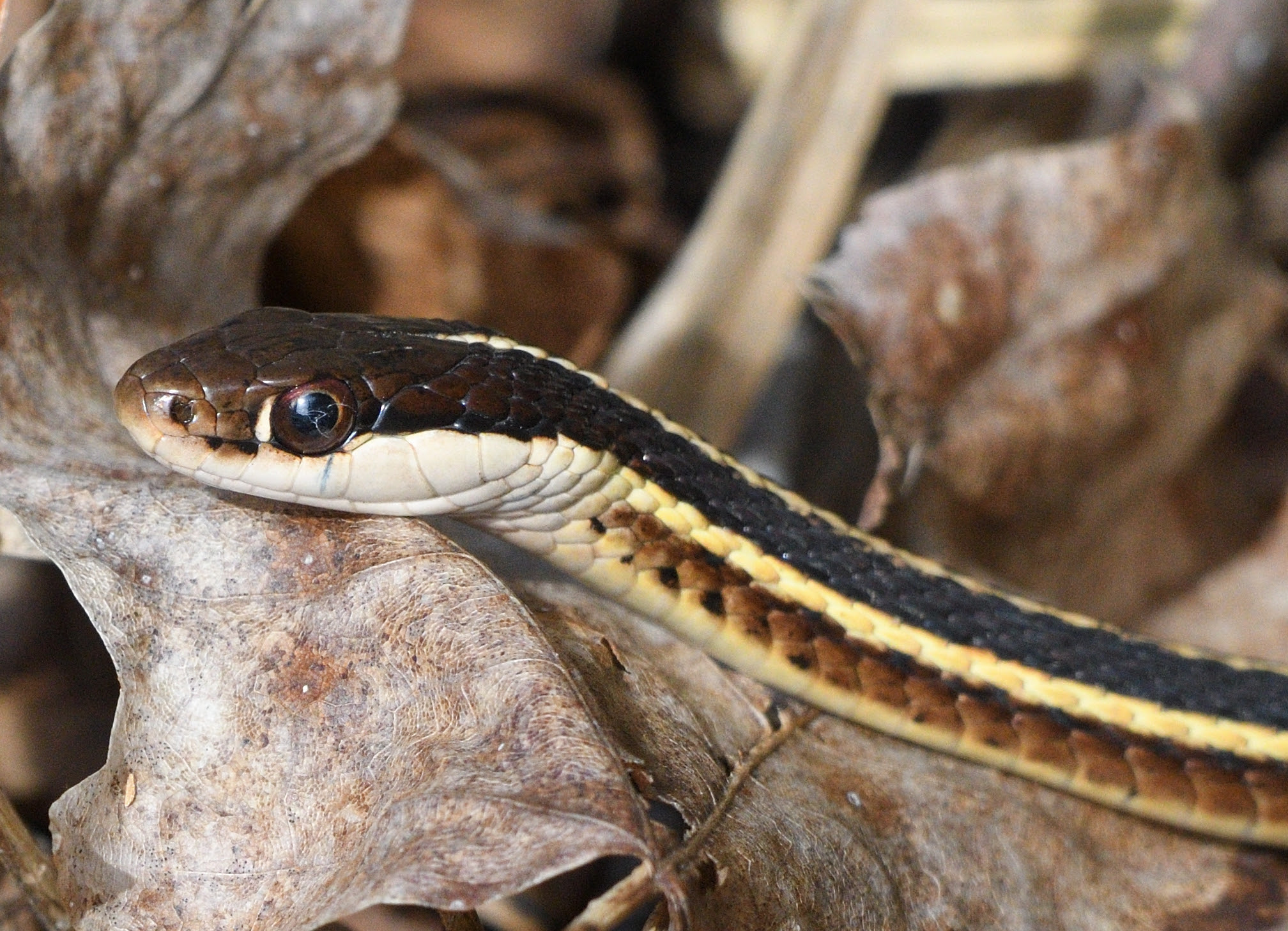
The photo above shows an Eastern Ribbonsnake, an S2 species of special concern in Vermont, which was photographed by Grace C. In 2026, we received 11 verified reports of Eastern Ribbonsnakes. One of these (found and photographed by Mary Droege and her son) was the first documented Ribbonsnake in Castleton. This species looks similar to the Common Gartersnake, but has some unique field marks: a bright white upper lip, reddish-brown color on top of the head, a white bar in front of the eye, a thin black line behind the eye, and a mahogany stripe on the lower sides. Keep your eyes out for this rare species and have your camera ready to snap a photo!
A short update on some of our recent work
(for more information, visit our GoFundMe page)
New records
From October 1, 2025, through September 30, 2026, 970 (649 new) contributors provided 5,686 new records that were entered into the Vermont Reptile and Amphibian Atlas Database. This brings the total number of reports entered to almost 135,000.
Sightings during this period came from 246 towns, cities, grants, and gores, and all Vermont counties. They included all of Vermont’s native species except Boreal Chorus Frog (probably extirpated from Vermont, last reported in 1999), North American Racer (last reported in 2024), and Fowler’s Toad (last reported in 2021).
Over the past year, we have entered 391 verified new reports of S1 species, 116 verified reports of S2 species, 2,060 reports of S3 species, 201 reports of S4 species, and 2,512 reports of S5 species. We have filled in at least 72 data gaps for S4 and S5 species over the past year. In addition, we have added negative reports (unsuccessful searches), unverified reports, reports of significant crossing areas, reports of significant herptile habitat, and data from long-term monitoring sites into our database.
Our surveys
During this period, we personally visited 53 “towns” (including cities, gores, or grants) to gather new records or update old reports. Many survey trips focused on those “towns” that have had the least survey effort. This is usually the result of low numbers of residents. Other trips focused on species that are not often reported by citizen scientists. These include the Northern Dusky Salamander and Spring Salamander. We also worked with Luke Groff of VT Fish and Wildlife on our annual search for North American Racers in southeastern Vermont.
Field trips, presentations, and media outreach
During this time, we had WCAX with us on one turtle event and we provided our annual interview on Vermont herptiles for Vermont Public’s Vermont Edition. We did another Habitats and Highways training in collaboration with the Vermont Agency of Transportation and Fish and Wildlife.
Presentations and/or field trips were provided for, or in association with, the Salisbury Conservation Commission, the Forest and Field Club (in Ferrisburgh), the CVU Forest and Field Class, Shelburne Farms, the Shelburne Natural Resources and Conservation Commission, the Dummerston Conservation Commission, the Caledonia County Natural Resources Conservation District, Vermont Center for Ecostudies, ECHO, Vermont State University Castleton, the Dead Creek Wildlife Festival, and the Herricks Cove Wildlife Festival. In addition, my assistants Kate Kelly and Ira Powsner each helped with bioblitzes in association with ECHO, and Ira gave a presentation for ECHO.
Update of the website and outreach
Regular updates and improvements have continued to be made to our website by Kate Kelly and Kir Talmage. In addition, we send out periodic Herp Update newsletters to a group of over 600 people and the local press. These updates get added to our website and our social media pages so that they are available to anyone. Our Facebook page (~4,295 followers, up from 3,400 last year) and new Instagram account (now with 332 followers, up from ~200 followers last year) have been quite successful, with 709,154 views of our regular Facebook posts, and 27,347 views on Instagram. We updated information on our remaining data gaps, and kept up-to-date information on upcoming presentations and field trips on our website. We updated the Vermont Herp Conservation Status list to reflect changes made in cooperation with VT Fish and Wildlife.
Learn more about our 2026 accomplishments and 2027 goals at our GoFundMe page. Thank you for your support!


