Herp Update: Recent Herp Activity, Spring Amphibian Migration, Fundraising Goal Surpassed!

Recent Herp Activity
While most of our herps are cooled down and not moving much this time of year, one of our species (the Mudpuppy) is quite active and is sometimes caught by anglers while ice fishing. We’ve received two reports of Mudpuppies in the last two weeks, both from ice fishermen. One of these reports was from Brattleboro in a backwater of the Connecticut River (where most Mudpuppies are introduced), and one was from Lake Champlain in Burlington (where Mudpuppies are a native species).
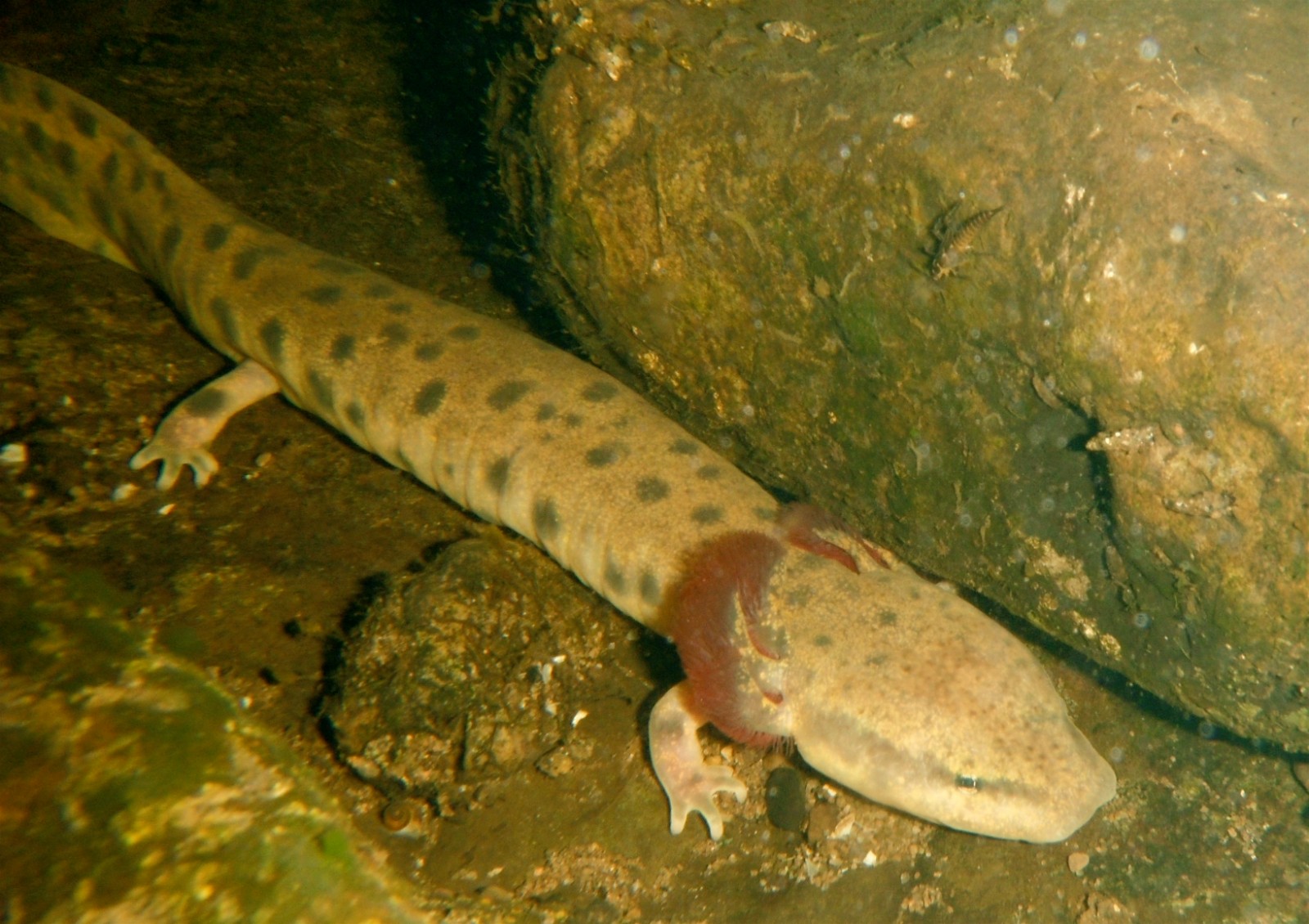
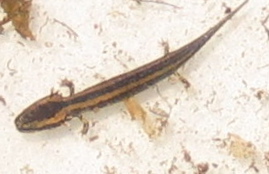
Mudpuppies are completely aquatic. They have external (red feathery) gills and grow to be quite large. The largest in Vermont was documented at 14.8 inches total body length. Juvenile Mudpuppies have broad yellowish stripes. As adults, they are all brown with black blotches. Their tail is laterally compressed (like a fish), and their snout is broad and squared.
All of our salamander species go through a larval phase, during which they have external gills. Most of these species (but not the Mudpuppy!) then metamorphose into a terrestrial adult. Sometimes, people refer to young larval salamanders of other species as mudpuppies, but it is worth noting the habitat you are in and your location if you are wondering if you saw a Mudpuppy or a different species. Mudpuppies are only known from the Lake Champlain and Connecticut River drainages in Vermont (and primarily from the large river systems in those drainages). If you’re in an isolated pond or a mountain stream, you’re most likely looking at the larva of a different species of salamander! We welcome reports of Mudpuppies (and all other) Vermont herptile species.
Photos: Adult Mudpuppy above by Kiley Briggs. Juvenile Mudpuppy below by Mark Ferguson.
Spring Amphibian Migration
My wife and I are about to head south for a couple of weeks of warmth, birding, and herping. Although our cold temperatures and solid snow cover may make it hard to believe, spring amphibian migration could begin while we are away, at least here in the Lake Champlain Basin. Back in 2017, we had a significant movement of Blue-spotted, Eastern Red-backed, Four-toed, and Spotted Salamanders, along with Spring Peepers and Wood Frogs, on March 1! This is the earliest date we have seen a migration at our Morgan Road site here in Salisbury. In 2024, the first migration was reported on March 5. In 2016, migration was first reported here in the lowlands on March 10. On the other hand, we have had significant numbers of Blue-spotted Salamanders (an early-spring migrant) as late as April 15 in 2017. That was the same year migration began on March 1. There was a return of cold weather after March 1 of that year.
Of course, migration at higher elevations and higher latitudes usually begins later in the year, and some species, such as Gray Treefrogs, wait for warmer weather before migrating.
I should mention that while most of our spring migrants are traveling to wetlands to breed and lay their eggs, the Eastern Red-backed Salamanders are simply moving from their overwintering locations downslope into wetland edges for the moisture and food provided there.
As a general rule, conditions for amphibian migration are some open water on the edges of wetlands, pools, and ponds, patches of snow-free open ground in the woods, rain, and temperatures above freezing (the warmer the better).
If you get out looking, let us know what you find, how many, and where you found them. A photo of each species found is very useful.
Our Annual Fundraising Goal has been Surpassed
We surpassed our fundraising goal of $25,000 today. We have raised over $25,400 since we began our fundraiser on November 11. We really appreciate your donations. Our fundraiser is the largest single source of funding we have. Other regular sources are the Lintilhac Foundation, the South Lake Champlain Fund of the Vermont Community Foundation, the Forest Ecosystem Monitoring Network of VT Forests and Parks, and a State Wildlife Grant from Vermont Fish and Wildlife.
We are shutting down our GoFundMe site today, but you can be assured we will be happy to receive donations anytime that works for you. Donations can still be made.
- By sending a check made out to James S. Andrews to: The Vermont Reptile and Amphibian Atlas, 642 Smead Road, Salisbury, VT 05769
- Via our online shop or the PayPal button on our website
- Or if you need to donate to a 501c3 non-profit, you can send a check made out to Vermont Family Forests to: The Vermont Reptile and Amphibian Atlas, 642 Smead Road, Salisbury, VT 05769. Vermont Family Forests is our fiscal sponsor, and they are a registered 501c3 non-profit.


