Herp Update: Mink Frogs

Current Activity
Mink Frogs
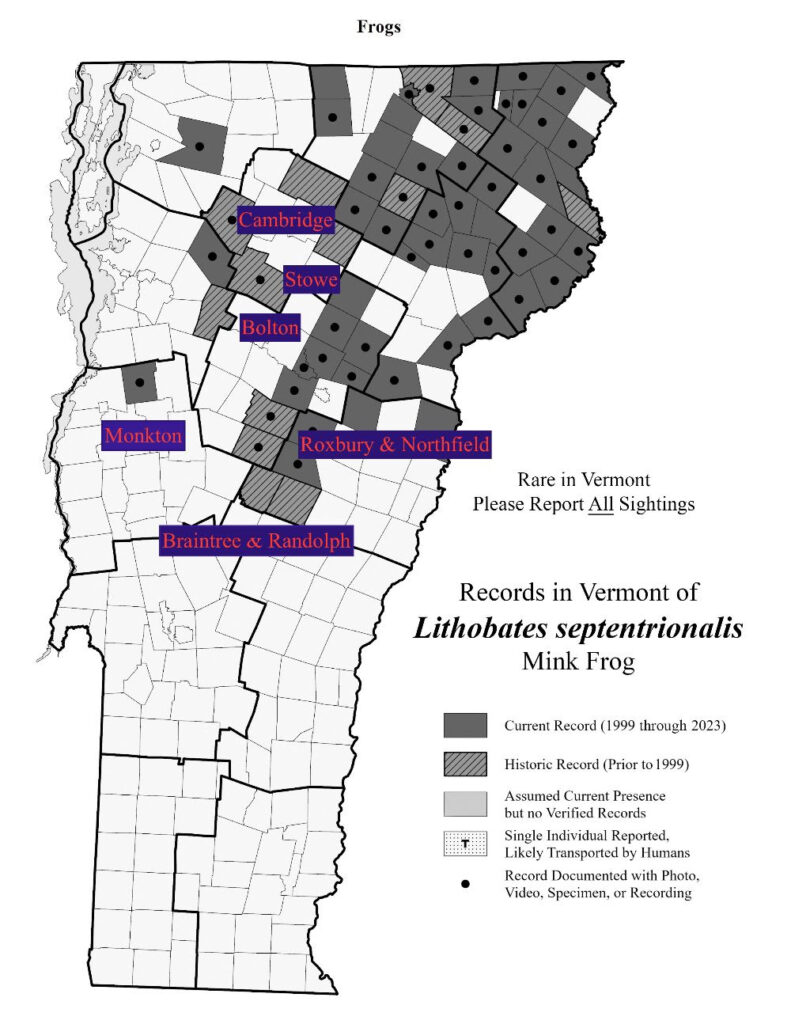
Mink Frogs should be calling now and for the next few weeks. They are a Canadian species whose range extends into Northeastern VT, from Randolph and Braintree to Canaan. Check out our map of Vermont reports below. The Braintree and Randolph reports are not well documented. We prefer to have photographs or recordings of calls, and for these two reports, we do not have either. However, the Roxbury and Northfield reports were well documented but came from 1988. Since it has been more than 25 years since Mink Frogs were reported from those two towns, we consider them historic reports and can not be confident that they still exist in either town. The isolated Monkton report was a surprise. They were first photographed and reported from the wetlands at the base of the Raven Ridge Natural Area in 2021 and have since been reported from there as well as adjacent wetlands multiple times. Notice that the Bolton, Stowe, and Cambridge reports are all now more than 25 years old and need to be updated. Can you help us out by updating any of the old reports shown on our maps? Can you find a previously unreported location in Elmore, Morristown, Hyde Park, or the many other northeastern VT towns from which they have never been reported?
Identifying Mink Frogs
The easiest way to identify a population of Mink Frogs is by learning their call and listening for it during the evening at this time of year. It is unlike the call of any of our other frogs. It sounds like hammering on wooden shingles or two resonant wooden sticks being hit together. It is often described as sounding like “cut, cut, cut.” An entire chorus of them sounds like horses’ hooves pulling wagons down a cobblestone street in an old western movie.
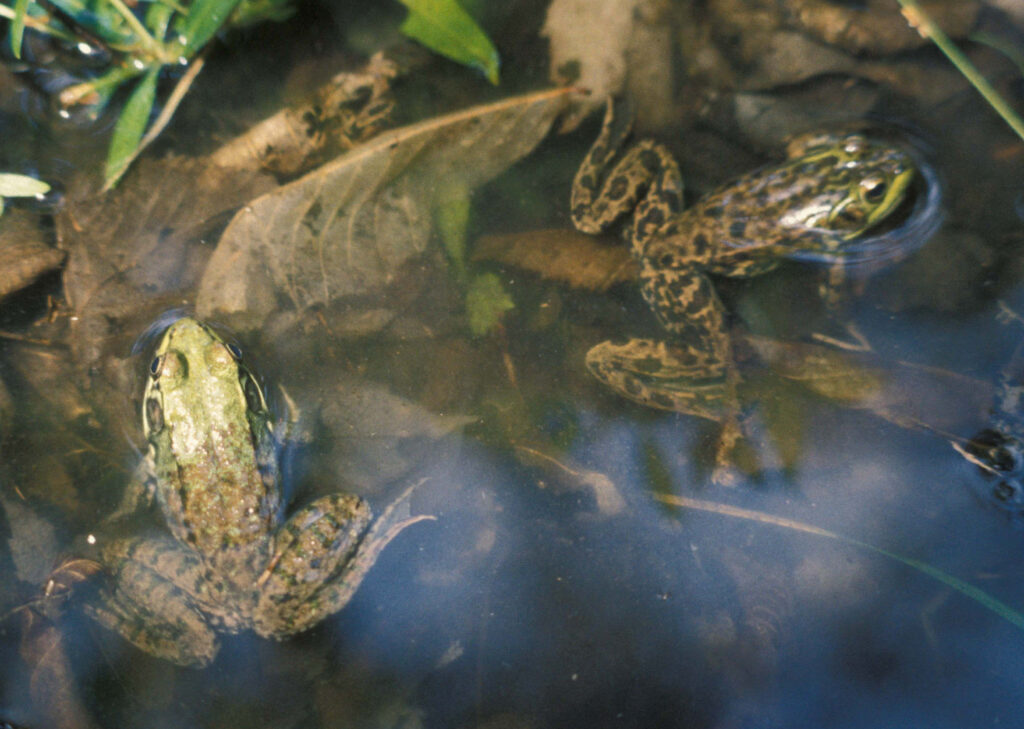
The photo below shows the very common and widespread North American Green Frog on the left and a Mink Frog on the right. They are very similar in appearance. Like North American Bullfrogs, they both have solid green upper lips (green-faced frogs) and are otherwise a mixture of greens and browns with dark spots. To make it more difficult, Green Frogs vary a lot in their background color and the amount of spotting on their bodies. But if you focus on their hind legs, you will see that the Green Frog (on the left) has a series of dark stripes running across its hind legs, whereas the Mink Frog (on the right) has oval spots oriented lengthwise along the axis of its legs. North American Bullfrogs are similar but also have striped legs. However, if you see a frog that looks like a Green Frog or a Bullfrog with oval spots on its legs, you are probably looking at a Mink frog. If you can catch it, try the scratch and sniff test. Mink Frogs smell like garlic. All of our other frogs have no smell at all. Mink Frogs are also the smallest of the three green-faced frogs (Bull, Green, and Mink). They are closest in size to Wood Frogs.
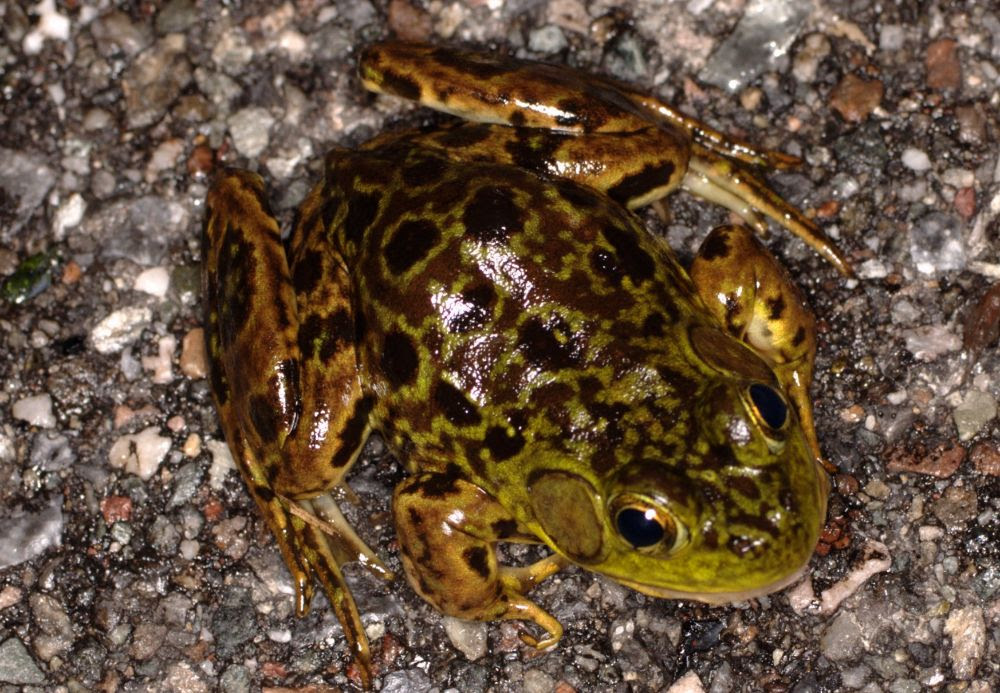
The two photos below show Mink Frogs. In both photos, you can see that spots continue onto their backs, but to varying degrees. Be careful here, because Green Frogs sometimes have spotted backs as well. Focus on the hind legs. You can see the spotting and the orientation of the oval spots clearly in both of these Mink Frogs.
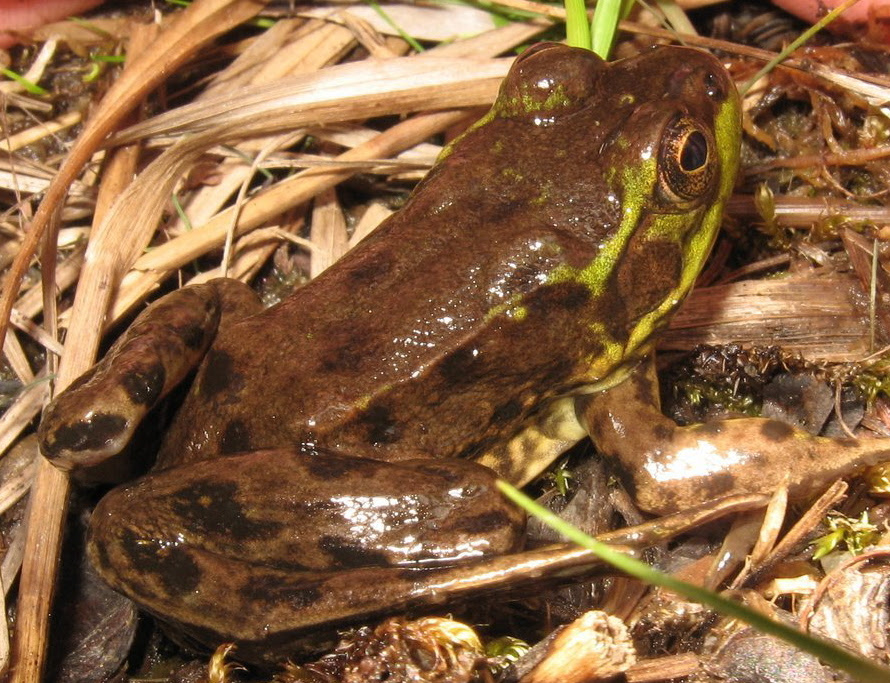
Mink Frogs are most often found in the shallow bays of cold, permanent water bodies, in the slow and still sections of their inlets and outlets, and sometimes in adjacent wetlands, ditches, and beaver ponds.
Since they require cold water that is high in dissolved oxygen, climate change could be pushing them out of some of their former habitat. Please be watching, listening, and smelling for this unique northern frog.


