Herp Update: Timber Rattlesnakes, Fundraiser

Presentation on Vermont Timber Rattlesnakes
 Herpers, I want to let you know about this upcoming presentation by Luke Groff, our Vermont Fish and Wildlife Herpetologist. I hope some of you can make it.
Thursday, February 12, 2026, 7 PM to 8:30 PM, at the Salisbury Meeting House (853 Maple Street) in the center of Salisbury, VT
Vermont Fish and Wildlife herpetologist Luke Groff will provide an overview of Vermont’s only venomous snake species, the Timber Rattlesnake. His presentation will touch on the species’ life history, historic and current distributions, and population threats, as well as past, current, and future conservation actions.
Luke is responsible for reptile and amphibian conservation statewide, as well as state lands management in Rutland and Bennington counties. He’s originally from Lancaster, Pennsylvania, but now lives in Danby with his wife and two young kids. He works out of Vermont Fish and Wildlife’s Rutland office.
This presentation is part of the Salisbury Conservation Commission’s winter series. It is free and open to the public.
The presentation will be at the Salisbury, VT Meeting House at 853 Maple Street.
Timber Rattlesnakes
Although they were once more widespread, Timber Rattlesnakes are currently only known in Vermont from western Rutland County. This is Vermont’s only venomous* snake; luckily for us, they are not aggressive (but don’t pick them up). Vermont had a bounty on them through 1971, but by 1987, they were protected and listed as endangered.
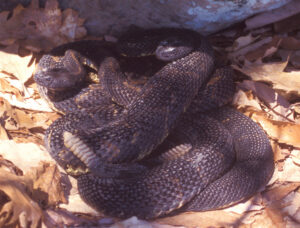
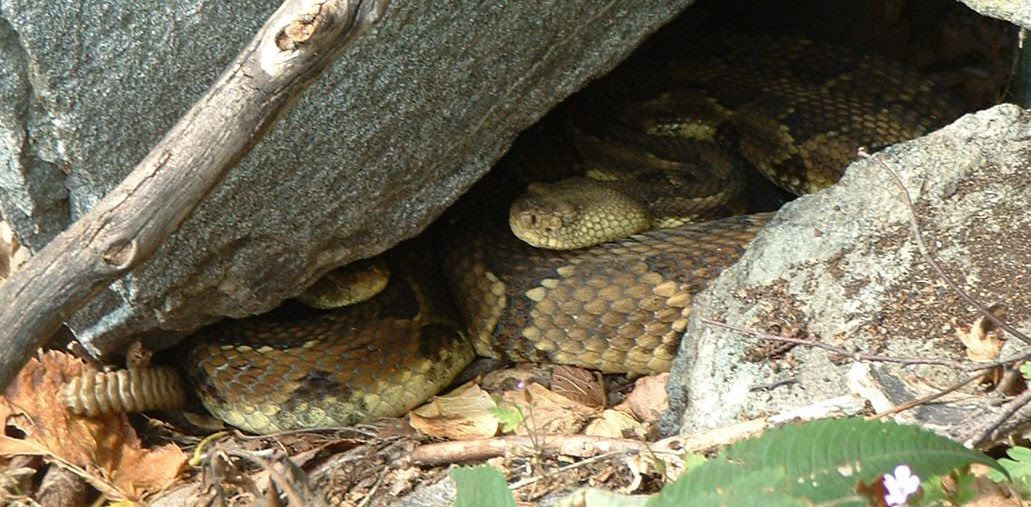
Notice the black heads of the two snakes in the photo above, taken by me (Jim Andrews). These two snakes are referred to as black-phase Timber Rattlesnakes. Black-phase Timbers also have very dark bodies. Yellow-phase Timbers have yellow or tan heads and light colored bodies. Yellow-phase Timbers show their patterns much more strongly, as you can see in the top photo taken by Jed Merrow. All Timber Rattlesnakes, no matter which color phase, have black tails. Other snakes will shake their tails when they feel threatened, and often this will make a buzzing noise, but only our Timber Rattlesnakes actually have a rattle. You can see the rattles in both of the two photos.
*We do have other snake species with mild venom designed to immobilize small prey such as salamanders, but their venom is not dangerous to humans.
Our Annual Fundraiser Continues
We have raised approximately $23,000 since we began our annual fundraiser on November 11. This is 92% of our goal of $25,000. Thanks again to all of you who have already donated. We realize that for many of our supporters, there are certain times of the year when it is most convenient for you to donate. You can be assured we will be happy to receive donations whenever it works best for you. That said, if you have not yet donated but are in a position to donate now, donations can be made in a few ways:
- By sending a check made out to James S. Andrews to: The Vermont Reptile and Amphibian Atlas, 642 Smead Road, Salisbury, VT 05769 (your donation stretches further, with no fees or overhead expenses)
- Through our GoFundMe site
- Via our online shop or the PayPal button on our website
- If you need to donate to a 501(c)3 non-profit, you can send a check made out to Vermont Family Forests to: The Vermont Reptile and Amphibian Atlas, 642 Smead Road, Salisbury, VT 05769.* Vermont Family Forests is our fiscal sponsor, and they are a registered 501c3 non-profit.
*If your fund requires that a check be sent directly to Vermont Family Forests (P.O. Box 254, 14 School Street, Suite 202A, Bristol, VT 05443), please notify them that your donation is for the Vermont Reptile and Amphibian Atlas, and please also contact us directly about your donation.
**Checks should not be made out to the Vermont Reptile and Amphibian Atlas. We can’t cash them that way.


