
Herp Update: Turtle Reports, Frogs Metamorphosing, Frogs Calling – July 9, 2025

Recent Herp Activity
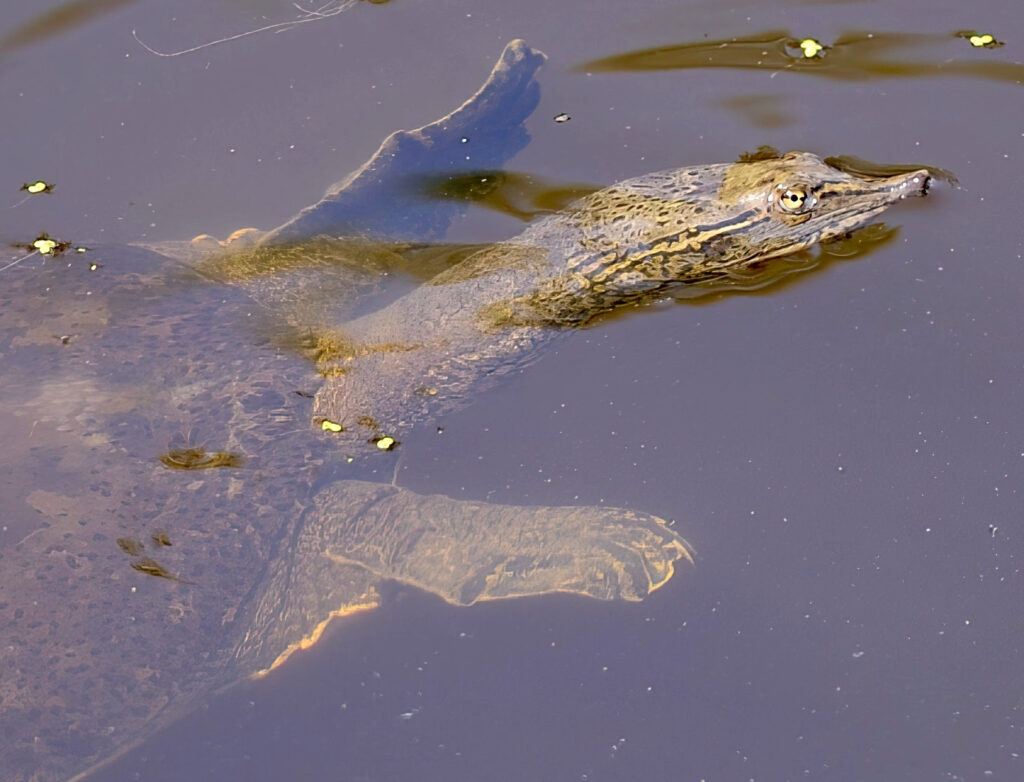
The reports of nesting turtles have almost completely ended but people are still reporting turtles seen in, or basking near, water. In the last week we have received photos of Vermont Wood Turtles, Spiny Softshells, Northern Map Turtles, and Eastern Musk Turtles. All great finds. See below for a nice shot of a Spiny Softshell taken in Alburgh by Robert Salter. It clearly shows the long thin neck, the pointed snout, and the webbed feet.
The rarest turtle reported over the last two weeks was the Spotted Turtle below photographed by David Korkuc. Unfortunately for us, it was a turtle found in Massachusetts. I passed that report along to my colleagues in that state. Spotted Turtles have been found in only three Vermont locations. One population is known in Windham County, one in Bennington County, and one in Addison County. Spotted Turtles are small. Adults are usually between 4 and 5 inches long (shell length). They are our only turtle with yellow spots on their shells. They don’t travel far from their home bogs and ponds, so they are most often reported by paddlers. Any report of a Spotted Turtle would be very exciting.

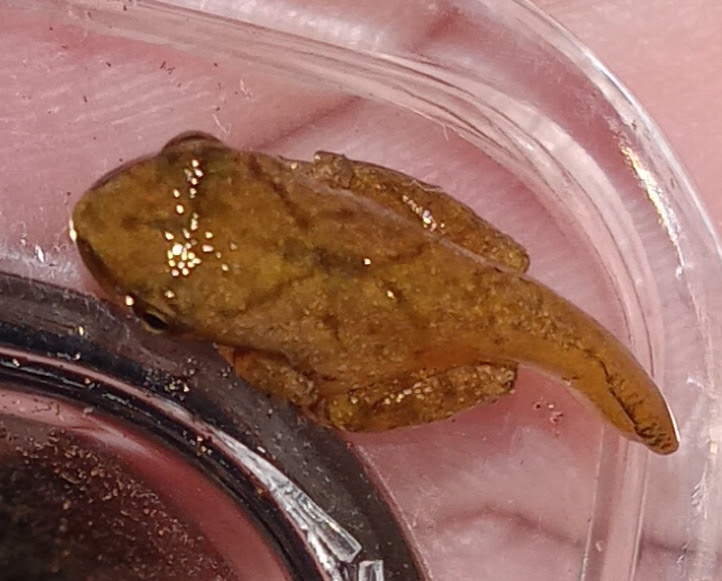
Some of the amphibian eggs laid this spring have already hatched, completed their tadpole stage, metamorphosed, and joined us on land. The young Spring Peeper below was photographed on July 7th in Castleton by Sue Clark. It will resorb its tail by moving those nutrients elsewhere in its body over the next few weeks. The X on its back is already clearly visible. Below the metamorph is an adult Spring Peeper my wife Kris photographed yesterday.
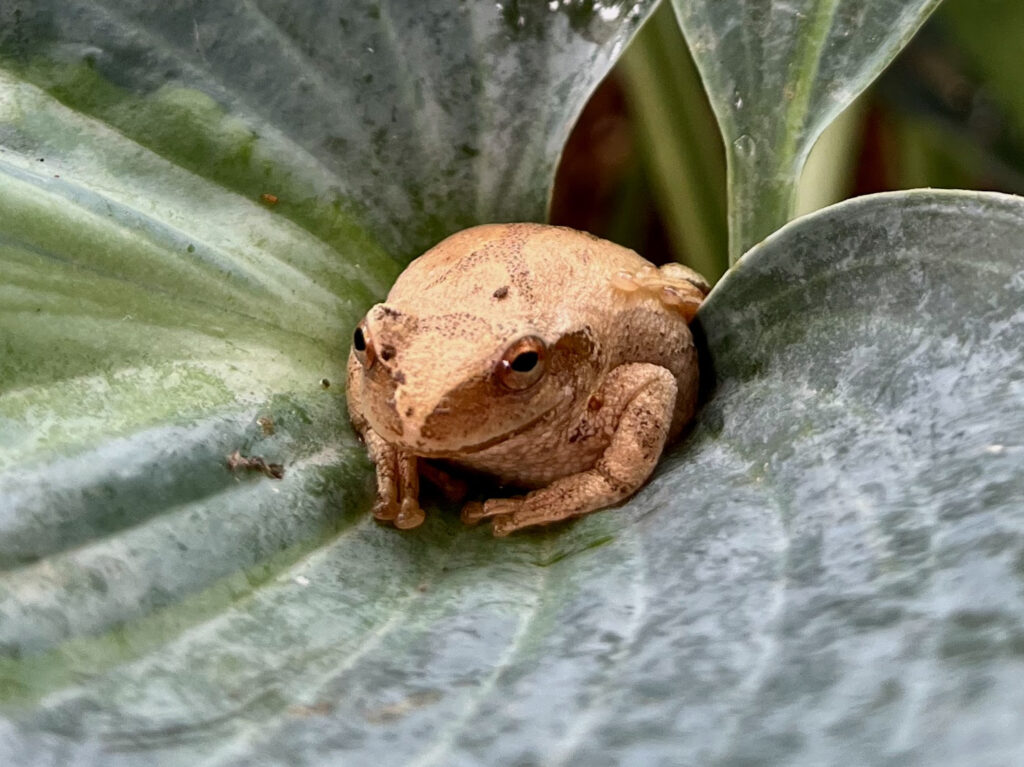
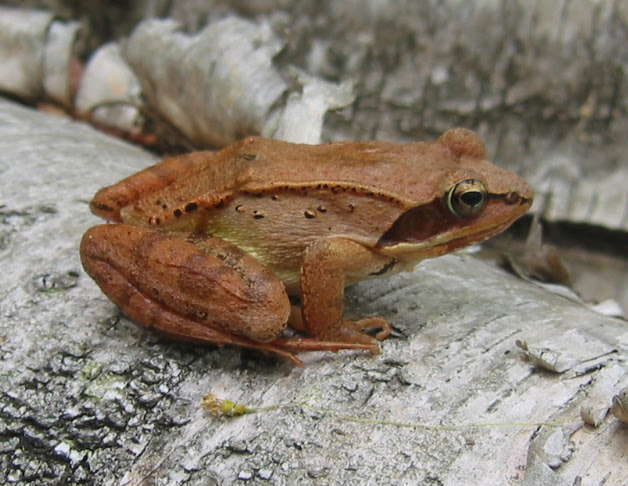
Notice the dark area below and both in front of and behind its eye. This dark patch leads some people to think Spring Peepers are young Wood Frogs. But Wood Frogs don’t have any adhesive discs on their toe tips, nor do they have an X on their backs like Spring Peepers. In addition, Spring Peepers have a smooth rounded back. In contrast, Wood Frogs don’t have an X on their backs, don’t have any adhesive discs on their toe tips (they don’t climb), and they have a thin fold of skin (dorsolateral ridge) on either side of their back. Erin Talmage’s Wood Frog photo below shows these differences.
What to Listen for Now
At the same time that some Spring Peepers have completed their development and left their natal ponds, this is peak calling and breeding season for North American Bullfrogs. Since Bullfrog tadpoles in Vermont overwinter at least one, if not two winters before transforming, and since they breed in water bodies that do not normally dry up, they are in no hurry to breed. Their deep and resonant jug-o-rum call is easy to recognize. Please do report any Bullfrogs that you hear. Bullfrogs have never been reported from over 50 towns in Vermont (~1/5 of all Vermont towns).
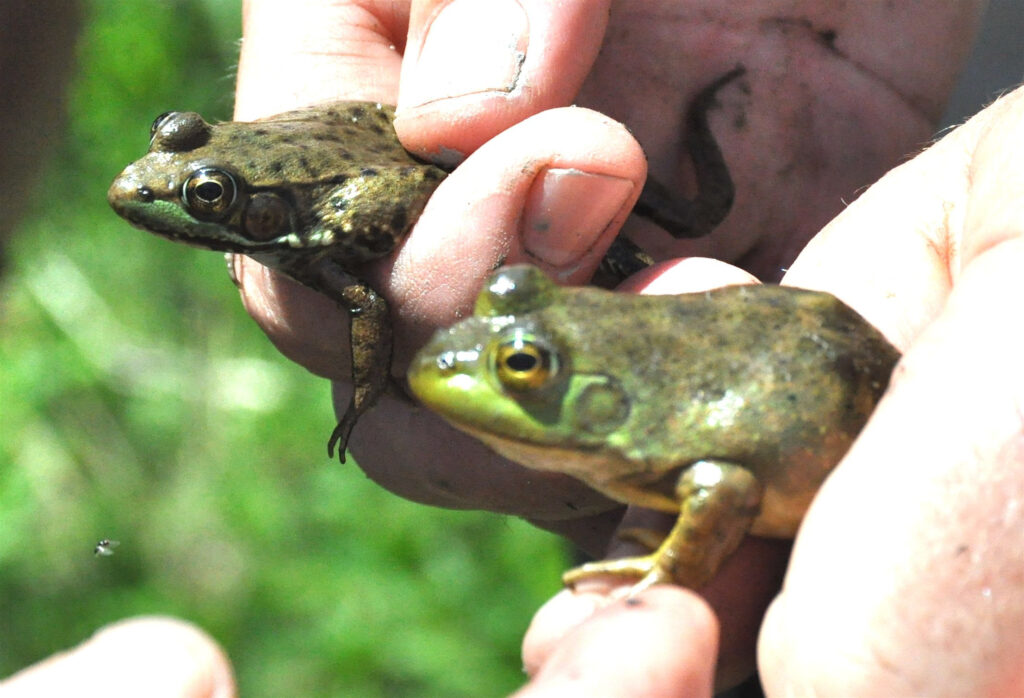
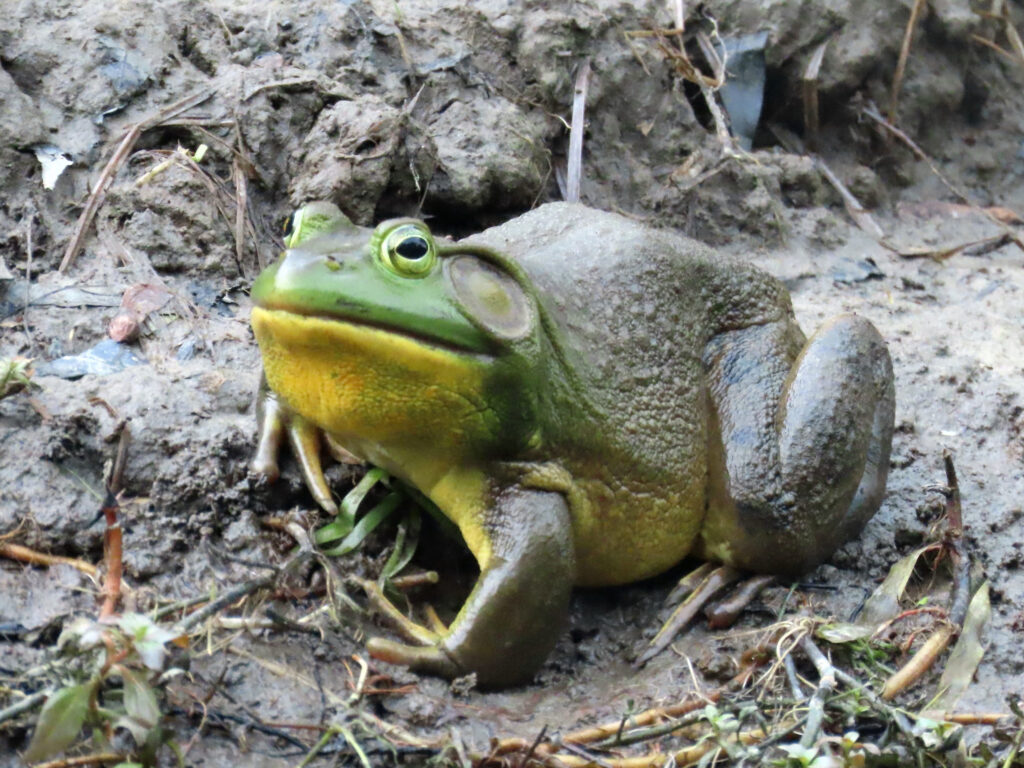
Katie Reilley’s photo below shows both a Green Frog in the rear left and a small Bullfrog front right. Notice that like the Spring Peeper, the North American Bullfrog also has a smooth and rounded back without ridges on either side. You can clearly see one of those skin folds on the Green Frog on the left. There are also differences in shape of the face (more rounded in a Bullfrog). Gary Starr’s photo on the bottom shows an adult Bullfrog. You can clearly see the lack of dorsolateral ridges and the rounded back on this large male. The yellow throat and ear drums (tympana) twice the size of his eye tell us that this is a breeding male.
It is much easier to document Bullfrogs by just reporting their calls. If possible, take a short video or audio recording that captures the call, but a report with no video is way better than no report at all.
Recent Survey Work
My daughter Ashley and I visited Topsham in late June to fill some data gaps. My assistant Ira Powsner and I followed that up with visits to Barnet, Sheffield, Stannard, and Wheelock and managed to document a dozen species including the first ever report and documentation (recording via video) of a Gray Treefrog from Wheelock. Despite our efforts in Stannard, we did not find any turtles. No one has every reported any turtle of any kind from Stannard. This is just one example of how we always need the help (reports) of people who live in, work in, or just visit Stannard and the many other Vermont towns that have not been well surveyed.


