Herp Update: Spotted Salamanders, Missing Species, “Common” Five-lined Skink, Fundraiser

Recent Herp Activity
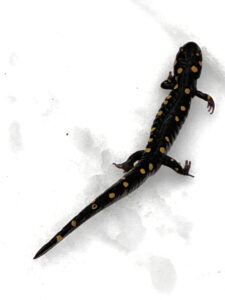
During the recent January thaw, we received two reports of Spotted Salamanders on the move. The photo below of a Spotted Salamander crossing a cross-country ski trail in Warren was taken by Katherine Burdine on January 9. The temperatures that day reached into the 40’s F. I hope this salamander got back below the ground before dark (and freezing temperatures). Spotted Salamanders are not freeze-tolerant.
We received a second photo of a Spotted Salamander on the move two days later from Vernon. Sadly, that one had been run over.
Missing Species
Kate Kelly and I spent some time yesterday updating our Missing Species list. We will have the new list up on our website later this week. This list only includes common reptiles and amphibians that have never been reported from a given town, common herps that have been reported but not backed up with a photograph, or common herps whose reports have not been updated for 20 years or more in a town.
We were pleased to see that this list is now 124 town/species combinations shorter than it was last year at about this time. We added a total of 4,816 new records last year, but only 124 filled in these data gaps.
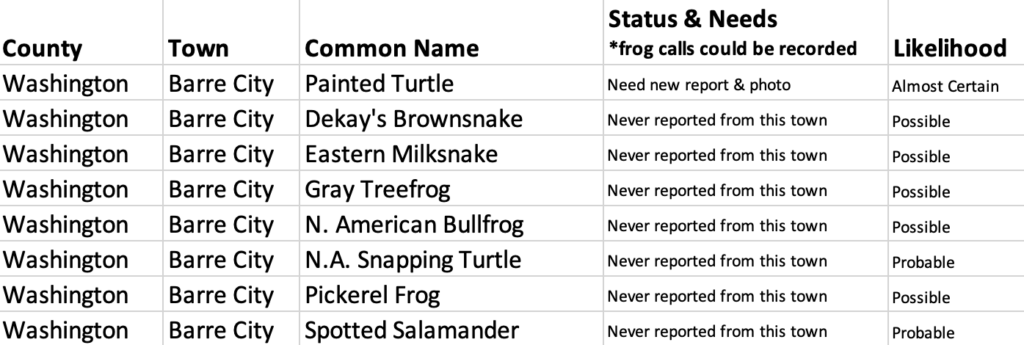
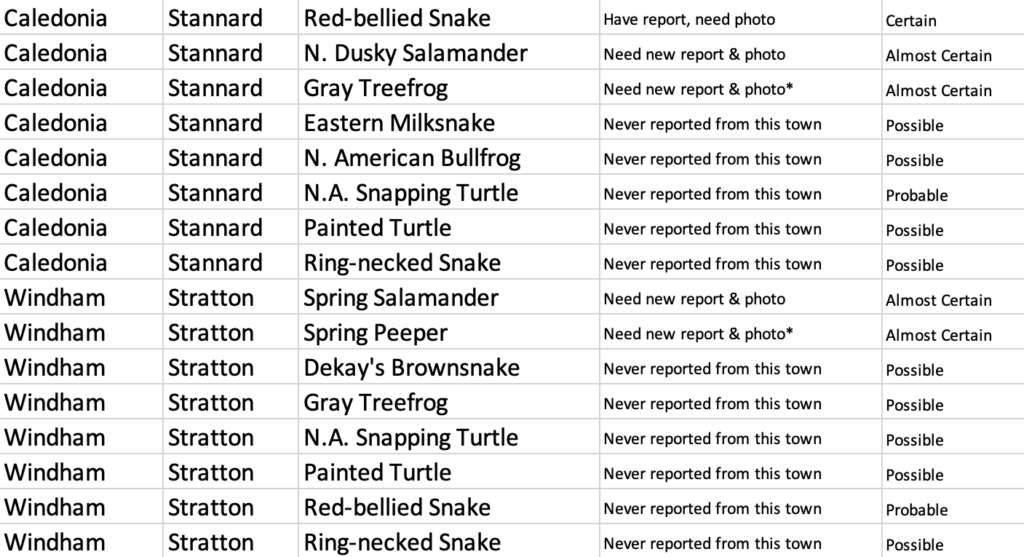
We use the Missing Species list to figure out which towns we should visit during the coming field season, and we also quote this list when we communicate with people who live in one of those towns. For instance, the three towns, cities, grants, & gores missing the most records of common and widespread species are Barre City, Stannard, and Stratton. All three towns are missing documentation of eight common herp species. In the case of Barre City (list shown below), it is entirely possible that there is no longer enough appropriate habitat remaining for them within Barre City limits, or there are too many other sources of mortality (roads, pollution, weed whackers, etc.) for them to survive.
However, in the towns of Stannard and Stratton that are also missing eight common species, there is certainly enough appropriate and connected habitat for most of the missing species to survive within the town limits. We have seven additional towns missing seven common species, and fifteen additional towns missing six common species. A single visit to any of these towns should fill in two or three of the listed gaps. You can check out your own town by visiting this list on our website and typing in your town name. We would really appreciate your help filling in any gaps this coming field season.
“Common” Five-lined Skink
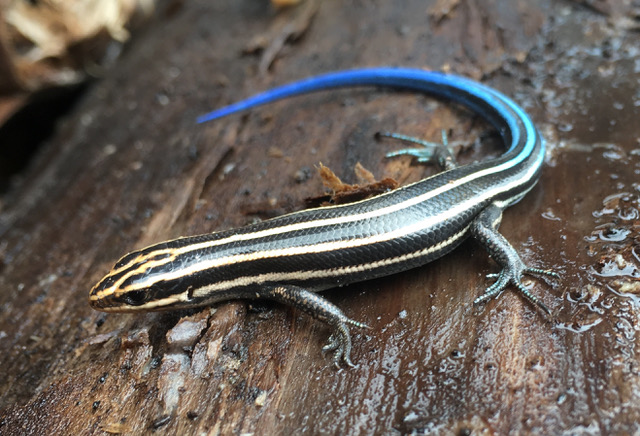
At the other end of the rarity spectrum is the “Common” Five-lined Skink shown below in Kate Kelly’s photo. Although its name suggests otherwise, this species is an S1, Endangered, High Priority species of greatest conservation need (SGCN). In Vermont, it has only been documented in Benson and West Haven. Its natural habitat is cliff faces, rocky talus slopes, and dead and down trees nearby. It is at the northern extreme of its range here in Vermont, and these open rocky areas provide the sun exposure and heat retention that they need to survive here. The rocky crevices also provide numerous hiding and hunting places. It also seems to need the climate-moderating effect of having Lake Champlain nearby. Skinks will explore for new habitat, and sometimes they take up residence on man-made structures that provide similar sun exposure, and hiding and hunting crevices. This could be an old barn, a porch, a wood pile, or perhaps an abandoned car. We were really pleased to pick up three additional locations for this species this year. All were associated with human dwellings in Benson and West Haven, within two miles of Lake Champlain.
The photo above shows a juvenile. As it matures, it will lose the blue coloration on the tail. Females keep faded stripes, but males lose them entirely and become solid brown with age. This species is Vermont’s only lizard.
Our Annual Fundraiser Continues
We have raised approximately $21,000 since we began our annual fundraiser on November 11. This is 84% of our goal of $25,000. Thanks again to all of you who have already donated. We realize that for many of our supporters, there are certain times of the year when it is most convenient for you to donate. You can be assured we will be happy to receive donations whenever it works best for you. That said, if you have not yet donated but are in a position to donate now, donations can be made in a few ways:
- By sending a check made out to James S. Andrews to: The Vermont Reptile and Amphibian Atlas, 642 Smead Road, Salisbury, VT 05769 (your donation stretches further, with no fees or overhead expenses)
- Through our GoFundMe site
- Via our online shop or the PayPal button on our website
- If you need to donate to a 501(c)3 non-profit, you can send a check made out to Vermont Family Forests to: The Vermont Reptile and Amphibian Atlas, 642 Smead Road, Salisbury, VT 05769.* Vermont Family Forests is our fiscal sponsor, and they are a registered 501c3 non-profit.
*If your fund requires that a check be sent directly to Vermont Family Forests (P.O. Box 254, 14 School Street, Suite 202A, Bristol, VT 05443), please notify them that your donation is for the Vermont Reptile and Amphibian Atlas, and please also contact us directly about your donation.
**Checks should not be made out to the Vermont Reptile and Amphibian Atlas. We can’t cash them that way.


