This chart was compiled by Megan Kane using frog length data from the Vermont Reptile and Amphibian Atlas Database in July of 2013 and was updated in 2025. The length of a frog is measured from snout to vent. The lengths of large adults of each Vermont frog species were averaged to determine the average adult length. Frog species were organized by average length, and this average includes the largest 10% for most species. For species with sample sizes over 1000, the largest 1% were included. Those species are marked with an asterisk after the species name. For the 2025 update, we checked to see if the largest individuals for each species had changed (or had been corrected) and adjusted the average adult sizes or record sizes only as needed. Due to a lack of data on Fowler’s Toads and Boreal Chorus Frogs, we included average lengths and records from Conant and Collins (1998).
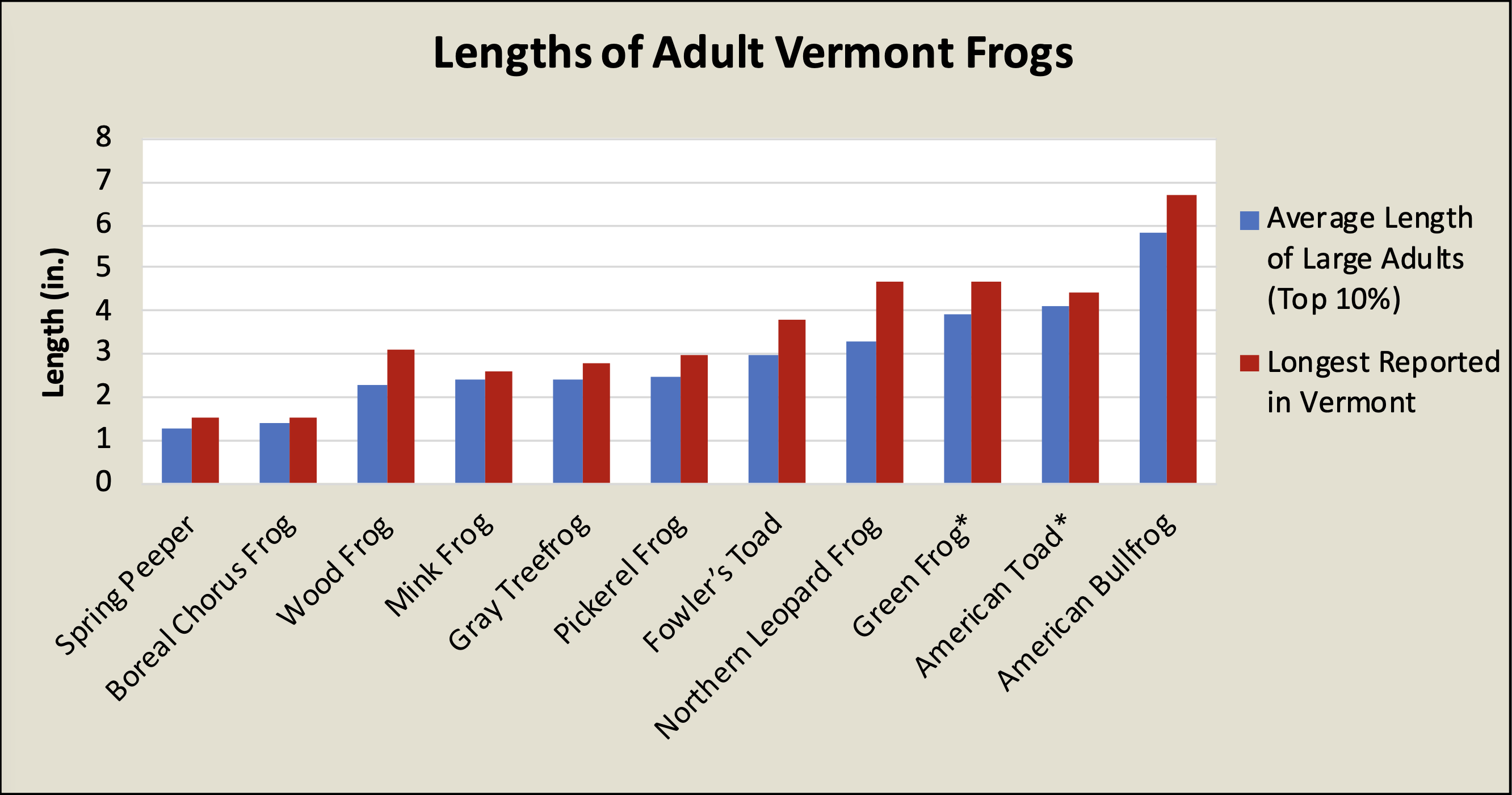
The lengths in the left numerical column are those you would expect for mature adults of these species in Vermont. The right numerical column shows the number of individuals that made up the sub-sample for that species. The lengths in the middle are those for the largest, reliably-documented frog of that species from Vermont. Can you document a larger one?
| Length Data for Largest 10% of Adult Frogs in Vermont Measured in inches from snout to vent |
||||
|---|---|---|---|---|
| Species | Average Adult Length | Longest Reported | Sample Size | Person(s) Who Recorded Longest |
| Spring Peeper | 1.3 | 1.5 | 86 | Kir Talmage and Betina Mattesen |
| Boreal Chorus Frog | 1.4 | 1.5 | 0 | Conant and Collins 1998 |
| Mink Frog | 2.1 | 2.5 | 12 | Will Johnson, Hunter Robinson, James Andrews, Take PART |
| Wood Frog | 2.3 | 3.1 | 28 | Danielle Wasserman |
| Gray Treefrog | 2.4 | 2.8 | 8 | Mike Sweatt and Thomas Pomfret |
| Pickerel Frog | 2.6 | 3.25 | 38 | Declan Sullivan |
| Fowler’s Toad | 3.0 | 3.8 | 0 | Conant and Collins 1998 |
| Northern Leopard Frog* | 3.3 | 4.7 | 41 | Kate Willard |
| North American Green Frog* | 3.9 | 4.7 | 22 | Jake Maddocks |
| American Toad* | 4.1 | 4.4 | 13 | Maureen Rice and Colleen Jones |
| North American Bullfrog | 5.8 | 6.7 | 6 | James Andrews |
* For this species, as the sample sizes were over 1000, the largest 1% were included.
Work cited:
Conant, R. and J.T. Collins. 1998. A field guide to reptiles and amphibians of eastern and central North America. Third Edition, expanded, Houghton Mifflin Company, Boston Massachusetts.


